Can WhatsApp Messages Amount to Evidence of a Contract in Kenya?
Lessons from Ochiel v Okoth [2026] KEHC 106 (KLR)
Written contracts remain the most widely accepted form of contractual agreements because they provide clear and readily accessible evidence of both their existence and terms. In practice, however, many commercial and personal transactions are never reduced into formal writing.
In today’s digital era, agreements are increasingly formed through WhatsApp messages, SMS, and emails. This raises an important legal question: can WhatsApp messages amount to evidence of a legally binding contract in Kenya?
The High Court’s decision in Fredrick Ochiel v Kennedy Okoth [2026] KEHC 106 (KLR) provides critical judicial guidance on this emerging area of contract law.
Understanding Oral Contracts in Kenya
An oral contract is a verbal agreement between parties that is not documented in writing but is nonetheless enforceable, provided it satisfies the essential elements of a valid contract:
-
Offer
-
Acceptance
-
Consideration (something of value exchanged, e.g., money)
-
Capacity of the parties to contract
Under the Law of Contract Act (Cap 23), oral contracts are recognized as valid in Kenya, except where specific transactions are statutorily required to be in writing, such as:
-
Contracts for the disposition of interests in land
-
Certain guarantees and sureties
However, proving an oral contract can be challenging. Section 107 of the Evidence Act (Cap 80) places the burden of proof on the party alleging the contract’s existence.
Courts therefore require corroborative evidence, which may include:
-
Witness testimony
-
Conduct of the parties
-
Electronic communications, including WhatsApp messages, SMS, and emails
Ochiel v Okoth: Factual Background
The dispute in Ochiel v Okoth arose from an alleged oral agreement dated 11th September 2024.
Kennedy Okoth claimed that he leased an ultrasound machine to Fredrick Ochiel at a daily rate of Kshs 1,000 for 145 days. Ochiel denied the existence of any agreement, arguing that no written contract had been executed.
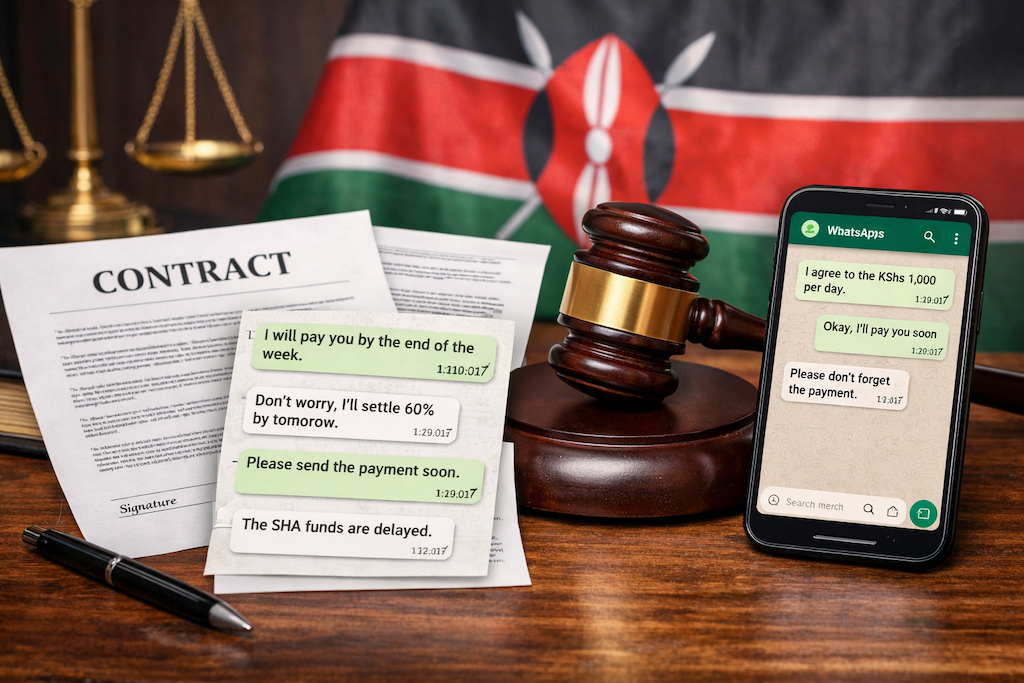
To prove the oral contract, Okoth produced WhatsApp and SMS messages exchanged between himself and Ochiel.
Key Evidence Presented
The messages revealed that:
-
Ochiel acknowledged hiring the ultrasound machine
-
He accepted the daily charge of Kshs 1,000
-
He repeatedly promised to make payment
-
He admitted payment delays were caused by late SHA disbursements
Additionally, Ochiel admitted in his witness statement that:
-
He collected the ultrasound machine
-
He made a partial payment of Kshs 5,000
These admissions were consistent with the digital messages.
The Small Claims Court ruled in favor of Okoth, awarding him Kshs 145,000 plus interest and costs. Ochiel subsequently appealed to the High Court.
High Court Determination: Are WhatsApp Messages Admissible Evidence?
The High Court, presided over by Justice D.K. Kemei, dismissed the appeal and upheld the judgment.
The Court held that:
WhatsApp and SMS messages clearly demonstrated a “meeting of minds” and sufficiently captured the contractual terms.
Key Findings by the Court
-
The digital exchanges covered:
-
Agreed pricing
-
Payment obligations
-
Performance timelines
-
Demands for return of the machine
-
-
Ochiel’s conduct — collection, use, and partial payment — corroborated the digital evidence.
-
Together, the evidence established existence of a binding oral contract.
Electronic Evidence and Section 106B of the Evidence Act
A pivotal issue was the admissibility of electronic evidence under Section 106B of the Evidence Act.
This provision requires:
-
A certificate of authenticity confirming:
-
Device integrity
-
Reliability of electronic records
-
Proper data handling
-
Court’s Position
Although the messages were not accompanied by a Section 106B certificate, the Court held that:
-
The Appellant failed to object during trial
-
The objection was therefore deemed waived
-
The messages were properly admitted into evidence
Key Legal Takeaways: WhatsApp Messages as Contract Evidence
1. WhatsApp Messages Can Prove a Contract
Where messages clearly demonstrate:
-
Offer
-
Acceptance
-
Consideration
-
Mutual intention
They can constitute strong contractual evidence.
2. Compliance with Evidence Rules is Critical
Section 106B certification remains essential unless waived by failure to object.
3. Conduct Corroborates Intent
Courts heavily rely on:
-
Partial payments
-
Possession of goods
-
Performance of obligations
Challenges and Practical Considerations
Despite judicial recognition, reliance on WhatsApp messages carries risks:
-
Message manipulation and fabrication
-
Ambiguity of casual conversations
-
Statutory writing requirements, especially in land transactions
Not all contracts can legally rely on digital communication alone.
Conclusion
The High Court decision in Ochiel v Okoth [2026] KEHC 106 (KLR) confirms that WhatsApp messages can constitute valid evidence of a contract in Kenya, provided they demonstrate clear mutual intent and contractual elements.
While digital communication now plays a central role in everyday transactions, legal prudence demands clarity, documentation, and proper evidence handling.
If you are involved in a dispute concerning oral contracts or electronic evidence, obtaining legal advice early is critical.
Need Legal Assistance?
For guidance on contractual disputes, electronic evidence, or commercial transactions Contact US
Email: info@wanjikumaina.co.ke
Tel: 0769 022 298